


Warning Signs
Diamond-shaped signs warning of road conditions ahead.
Read the warning symbol, identify the condition ahead, and adjust early.
Warning signs tell you about a dangerous or unusual condition ahead. Recognize the condition, scan for the hazard, and adjust early enough to stay in control.


Key facts
- Warning signs are usually yellow diamonds.
- Read arrows and supplementary panels as well as the main symbol.
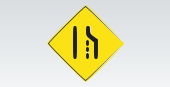
Recognize the warning-sign family
Ontario warning signs are usually diamond-shaped with a yellow background and black letters or symbols. The shape and colour tell you to prepare before you have decoded every detail of the symbol.
Warning signs describe a condition ahead. Regulatory signs give a direction that must be obeyed, so do not confuse a warning with a posted command.
Match the symbol to a safe response
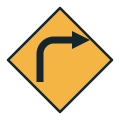
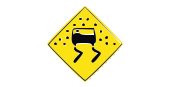
A curve sign shows the direction of a turn or bend ahead. A slippery-when-wet sign calls for slower, cautious driving when the surface is wet. A right-lane-ends sign tells drivers in that lane to merge safely into traffic on the left.
The sign starts your decision. Check mirrors and traffic, reduce speed when the condition requires it, and make any lane change only when there is a safe gap.
Read the whole sign
Small differences matter: the direction of an arrow, which side narrows, and any advisory speed or distance panel below the main sign. Name the condition first, then state the action it requires.
An advisory speed panel below a curve or ramp sign is a recommendation for that specific hazard in ideal conditions, not a posted legal limit; treat it as a floor to slow to, and go slower still if the road surface or visibility makes even that speed unsafe.


Common mistakes
- Memorizing “yellow diamond” without learning the symbol inside it.
- Treating an advisory warning as permission to ignore current traffic and road conditions.
- Merging immediately at a lane-ending sign without checking mirrors, blind spots, and the available gap.
- Confusing a curve warning with a mandatory turn or one-way sign.


Check your understanding
1. What does a yellow diamond-shaped sign usually tell you?
It usually warns of a dangerous or unusual condition ahead, such as a curve, dip, intersection, or lane change.
2. What should you do when you see a slippery-when-wet sign and the road is wet?
Slow down and drive with caution so you can maintain control on the reduced-traction surface.
3. A sign shows that the right lane ends ahead. What should a driver in that lane do?
Check surrounding traffic and merge safely into the lane to the left when a safe gap is available.
Related Ontario G1 guides
Official references
Facts reviewed .
63 questions available in this topic.
Start practiceYou can also take the free 5-question test or browse all Ontario G1 study guides.



Small steps. Safer roads.
Study today for a more confident tomorrow.