




Sign Shapes & Colours
What a sign's shape and colour tell you before you even read it.
Match the shape and colour to a family first, whether stop, yield, warning, regulatory, or guide, then read the specific symbol, arrow, or panel for the exact rule.
Ontario’s sign system is built so shape and colour tell you the category of message before you are close enough to read text: recognizing the family is the fast half of reading any sign.


Key facts
- The eight-sided stop sign and the inverted-triangle yield sign are each unique to their own meaning; no other Ontario sign uses either shape.
- Yellow diamonds are warning signs describing a hazard; white or black rectangles are regulatory signs stating a rule; green rectangles are information/guide signs for direction.


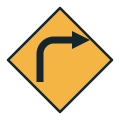
Learn the shape-to-family mapping
Octagon (red, white letters): stop, always a complete stop. Inverted triangle (white, red border): yield, slow and be ready to stop. Diamond (yellow, black symbol): warning, a hazard or unusual condition is ahead. Rectangle or square (white or black background): regulatory, a rule you must obey. Rectangle (green background, white letters): information or guide, route and destination help.
Orange is reserved for temporary conditions: construction and work-zone signs use an orange background specifically so they stand out from the permanent sign system.
Use colour as a first filter, not the final answer
Colour narrows what kind of sign you are looking at, but two signs of the same colour can require very different actions. A yellow diamond warning of a curve and one warning of a pedestrian crossing both demand attention, but for different hazards, so always read the specific symbol.
A regulatory sign’s green-circle-versus-red-circle-with-slash convention is a further layer within that one family: green circle means the action shown is permitted, red circle with a diagonal line means it is prohibited.
Read supplementary panels and translate to an action
A smaller panel below the main sign, such as an arrow, a distance, a time range, or an exception, can narrow which lane, direction, or hours the sign applies to. Skipping the panel is a common way drivers misapply an otherwise correctly identified sign.
Once you have identified the family and read the full sign, translate it into one driving action: stop, yield, slow and scan, obey the stated rule, or plan a route change. The shape and colour get you to the right question faster, and the full sign gives you the answer.


Common mistakes
- Assuming every yellow sign is a speed-limit sign rather than a warning sign describing a hazard.
- Ignoring an arrow, time range, or exception panel mounted below the main sign.
- Confusing an orange temporary-condition sign with a permanent yellow warning sign.
- Treating a green guide sign as a command rather than route information.


Check your understanding
1. You see an eight-sided red sign in the distance, too far to read the text. What does it require?
A complete stop: the octagon shape alone identifies it as a stop sign in Ontario, independent of the text.
2. What colour background is reserved specifically for temporary and construction-zone signs?
Orange, so drivers can immediately distinguish a temporary condition from the permanent sign system.
3. A regulatory sign shows a green circle around a symbol. What does the green circle mean?
The action shown inside the circle is permitted.
Related Ontario G1 guides
Official references
Facts reviewed .
27 questions available in this topic.
Start practiceYou can also take the free 5-question test or browse all Ontario G1 study guides.



Small steps. Safer roads.
Study today for a more confident tomorrow.