


School Zone & Railway Signs
Distinctively shaped signs for school zones and railway crossings.
A school-zone sign is five-sided and fluorescent yellow-green; a railway crossing sign is X-shaped, white with a red outline. Both mean slow down and watch carefully, but for different hazards.
A school-zone sign and a railway crossing sign each have a shape unique to their own family, and each demands a specific response the moment you recognize it.


Key facts
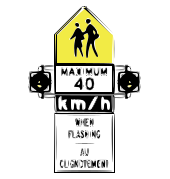
- A school zone sign is five-sided with a fluorescent yellow-green background and black symbols, a shape and colour combination unique to school areas.
- A railway crossing sign is X-shaped with a white background and red outline.

Recognize the school-zone sign family
A school zone sign’s five-sided shape and fluorescent yellow-green colour make it identifiable at a glance, distinct from the yellow diamond used for ordinary warning signs. It requires you to slow down, drive with extra caution, and watch for children.
A related sign warns of a hidden school bus stop specifically, telling you to slow down, drive with extra caution, watch for children, and watch for a school bus with flashing red lights, since a stopped bus can appear suddenly around a curve or hill in that kind of location.
Recognize the railway crossing sign
A railway crossing sign is X-shaped, with a white background and a red outline, a shape used for no other sign family in Ontario. It requires you to slow down and look both ways for a train, and to be prepared to stop.
A warning sign posted ahead of the crossing itself often shows the angle at which the tracks cross the road, which helps you anticipate exactly which direction to look as you approach, since not every crossing is a simple perpendicular intersection.
Let the strongest control decide, not the sign alone
A sign is a warning, not the final word: if a railway crossing also has flashing lights, a gate, or a stop sign, that control takes priority over the sign itself. Never treat the absence of a visible train as permission to proceed if a gate is down or lights are flashing.
The same layering applies to school zones: a posted sign, a reduced speed limit, and a crossing guard can all apply to the same stretch of road at once, and you must follow all of them together, not just the one you notice first.


Common mistakes
- Confusing a fluorescent yellow-green school-zone sign with an ordinary yellow warning diamond.
- Looking only for an oncoming train and missing a lowered gate or flashing light at a railway crossing.
- Assuming a school-zone sign alone sets a specific speed, when the actual reduced limit is often posted separately.
- Proceeding through a railway crossing as soon as a train has passed, without checking for a second train on an adjacent track.


Check your understanding
1. What shape and colour identify an Ontario school-zone sign?
Five-sided, with a fluorescent yellow-green background and black symbols.
2. What shape and colour identify an Ontario railway crossing sign?
X-shaped, with a white background and a red outline.
3. You approach a railway crossing and see no train, but the crossing gate is down. What should you do?
Stop and wait. The gate is a stronger control than the absence of a visible train, and you must not proceed while it is down.
Related Ontario G1 guides
Official references
Facts reviewed .
40 questions available in this topic.
Start practiceYou can also take the free 5-question test or browse all Ontario G1 study guides.



Small steps. Safer roads.
Study today for a more confident tomorrow.